Part two of our lazy Okanda adventure day finds us visiting a couple of very old temples (yes, more temples), situated on big granite domes in the middle of lagoons, forest, and the savanna country bordering the Kumana National Park. The first was a hindu temple, as mentioned in part one, called Ukanthamalai Murugan Kovil. The second was a Buddhist temple: the Kudumbigala monastery Complex.
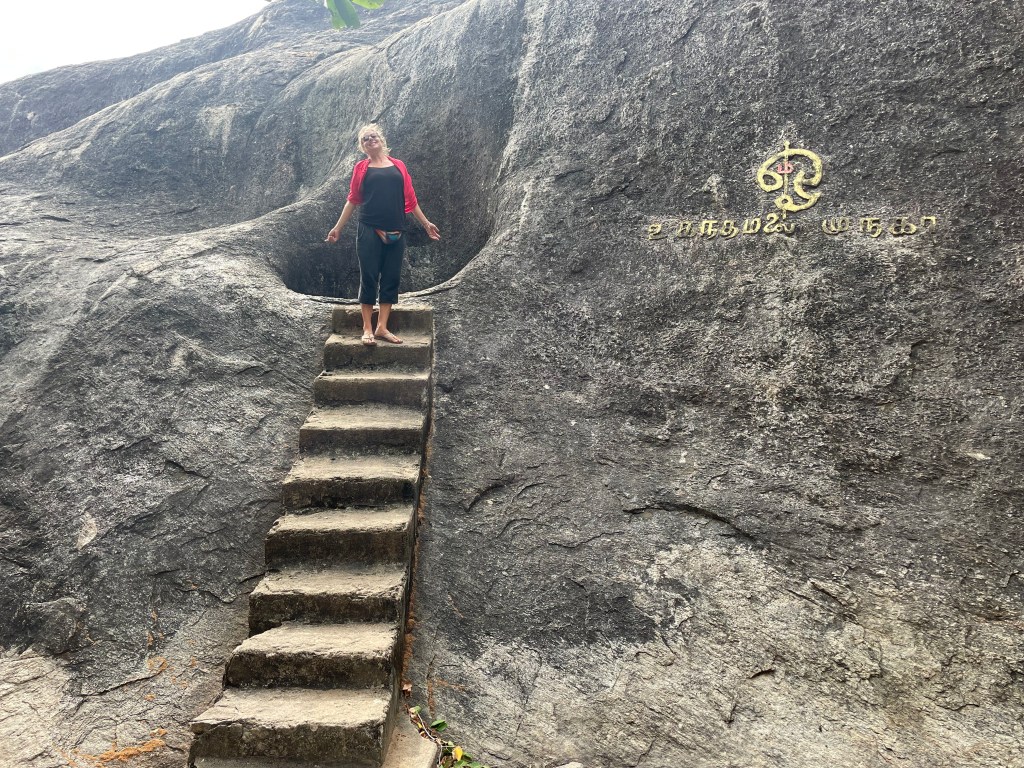
These are the stairs that lead you to the easiest path up the first of the two domes. There is a large temple complex at the base of the granite domes that we did not spend any time in, as it looked as though they were preparing for a festival of some sort (imposter syndrome here again).
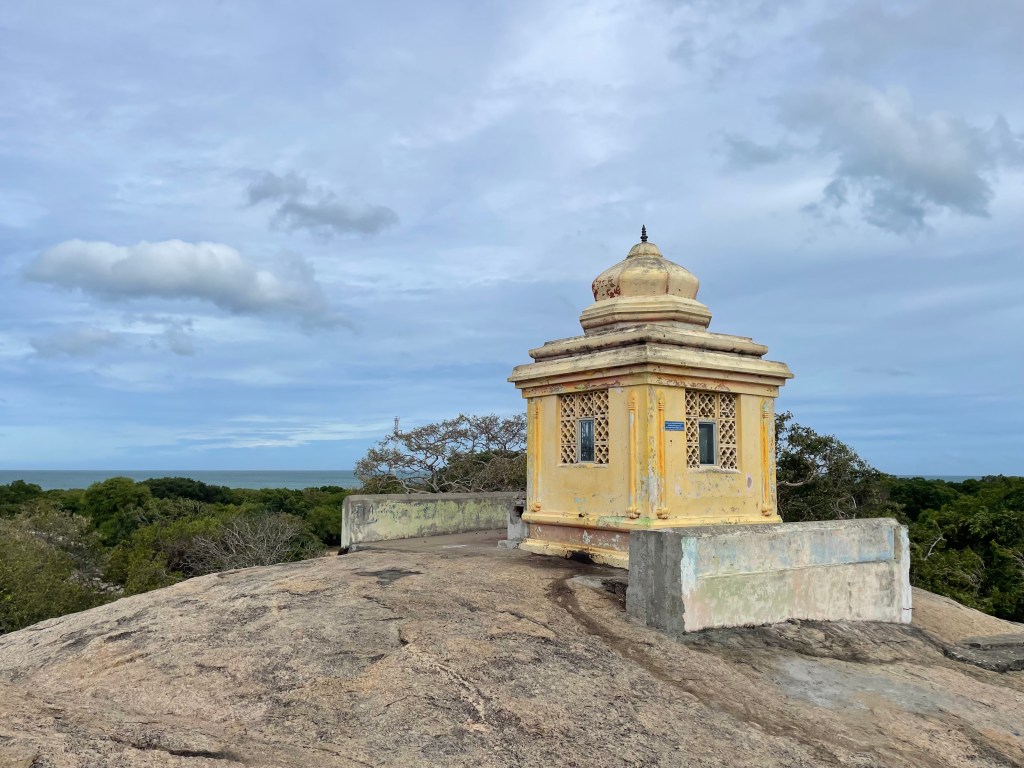

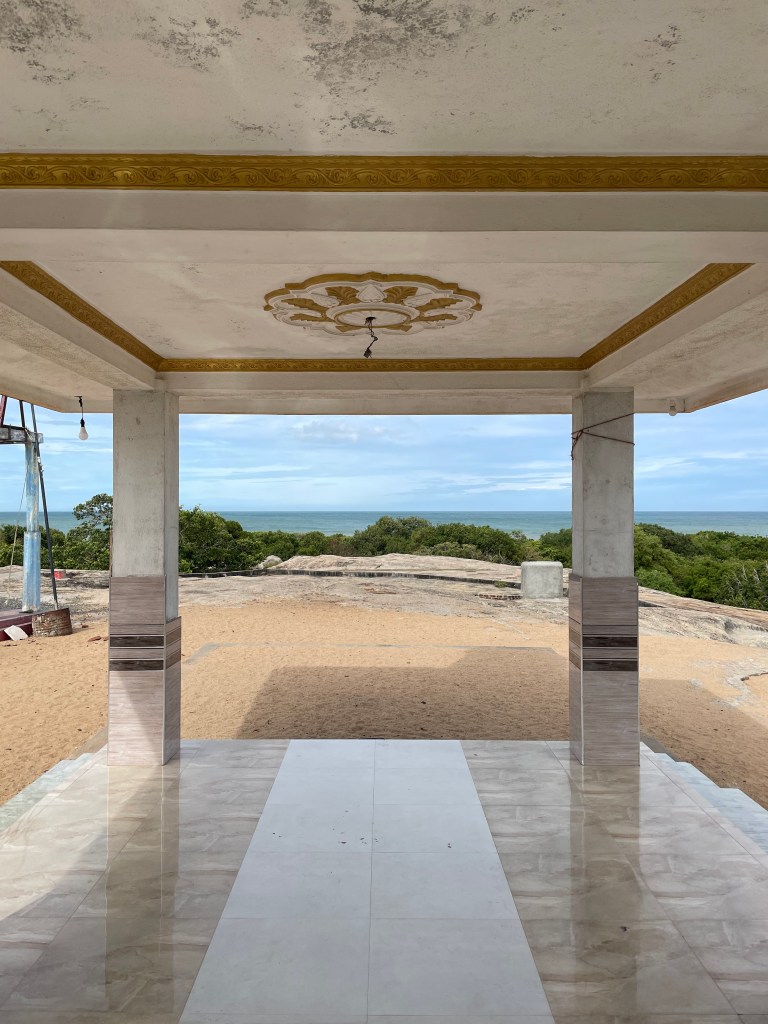
These are small temples that are located at the highest point of both domes, both with a complete view of each other, the surrounding forest, and of the ocean. This entire complex was built on a site that is believed to be where a divine spear, thrown by the god Skanda had stuck. It is also the place where Hindu deities and lovers, Murukan and Valli, arrived by boat and rested (or “sat”). There are several different legends about this, but one says that they arrived in separate golden boats, and that the rocks on Okanda beach are the remains of these two boats.
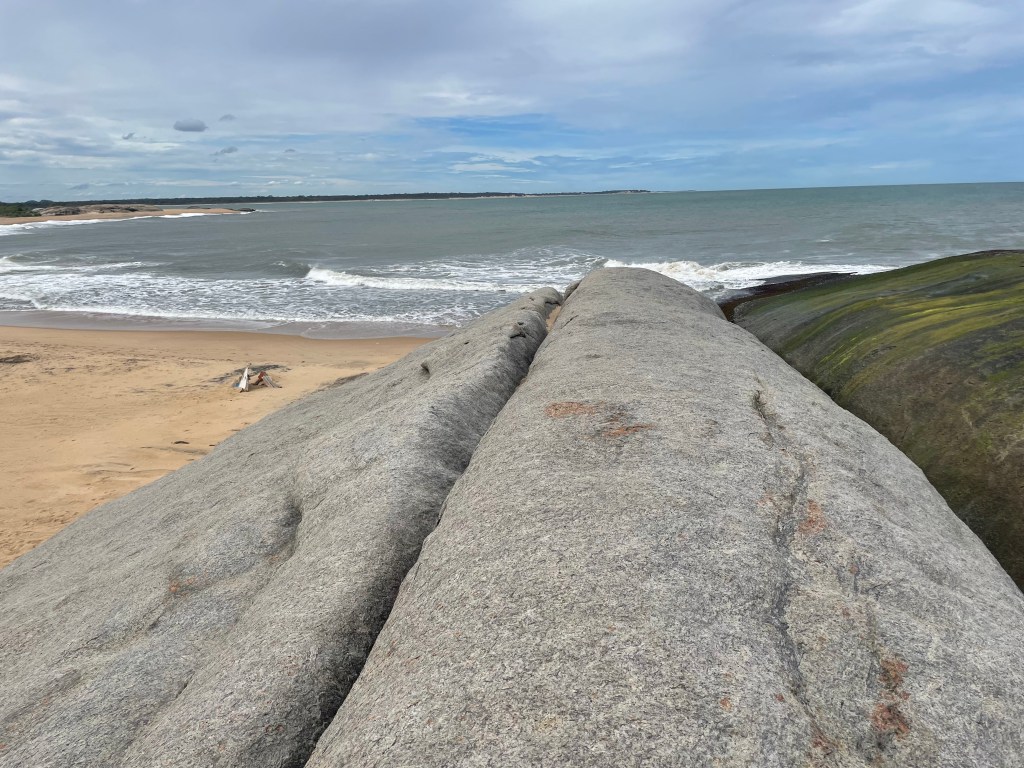
The view from the remains of the “boats” that the two lovers arrived in.
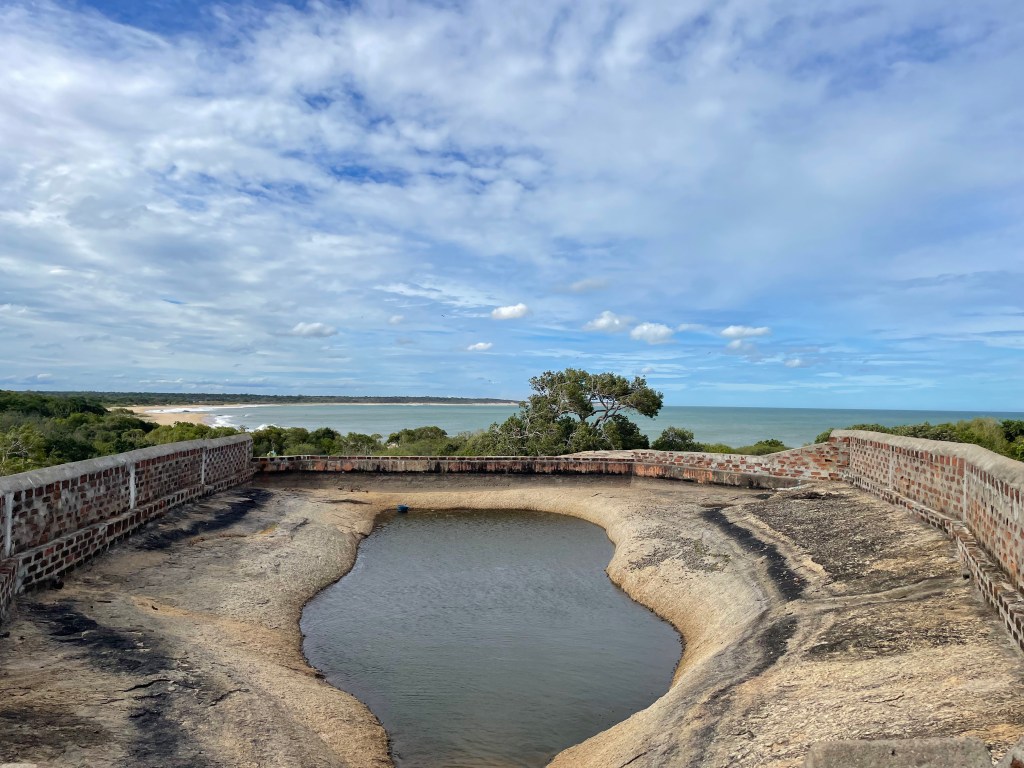
It is believed that this natural spring at the top of the granite dome is the footprint of the god Skanda. I don’t know if that is true, but the view up here is beautiful: the ocean, the beach, and the surrounding savanna and forests.
We then drove a mile or so through those same surroundings to get to the Buddhist temple.
The Kudumbigala temple complex is huge. It covers an area approximately one-half mile triangular shape encompassing the entrance temples and stupa, the lotus ponds, and the cylindrical dagaba on the largest of the granite domes.
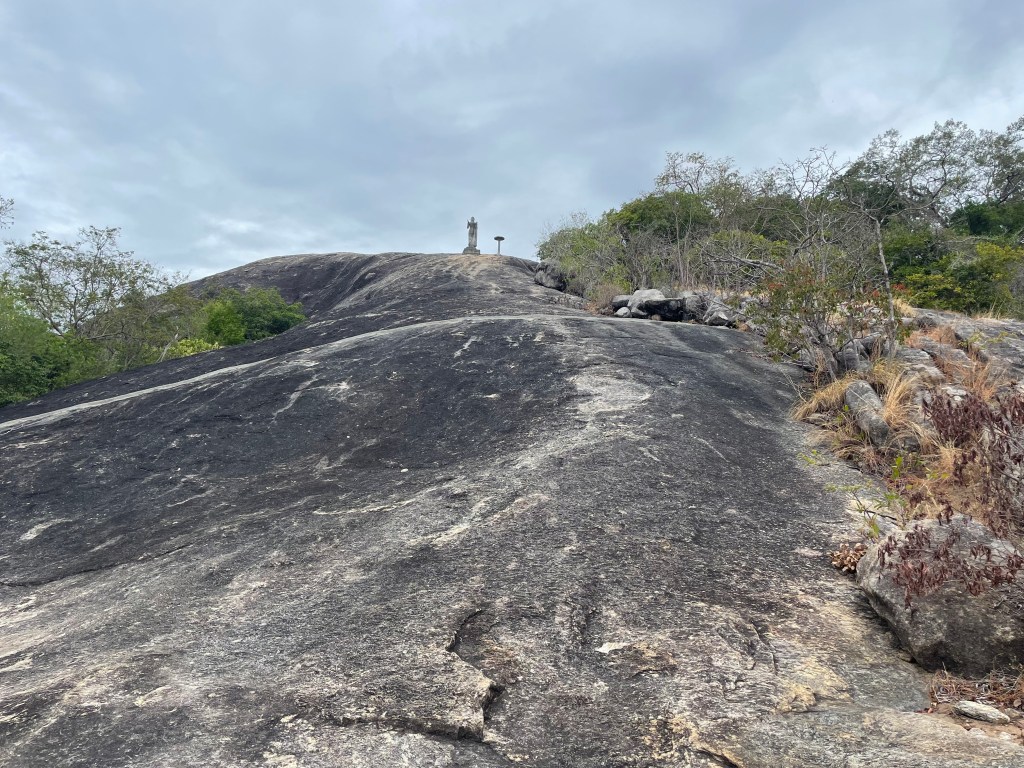
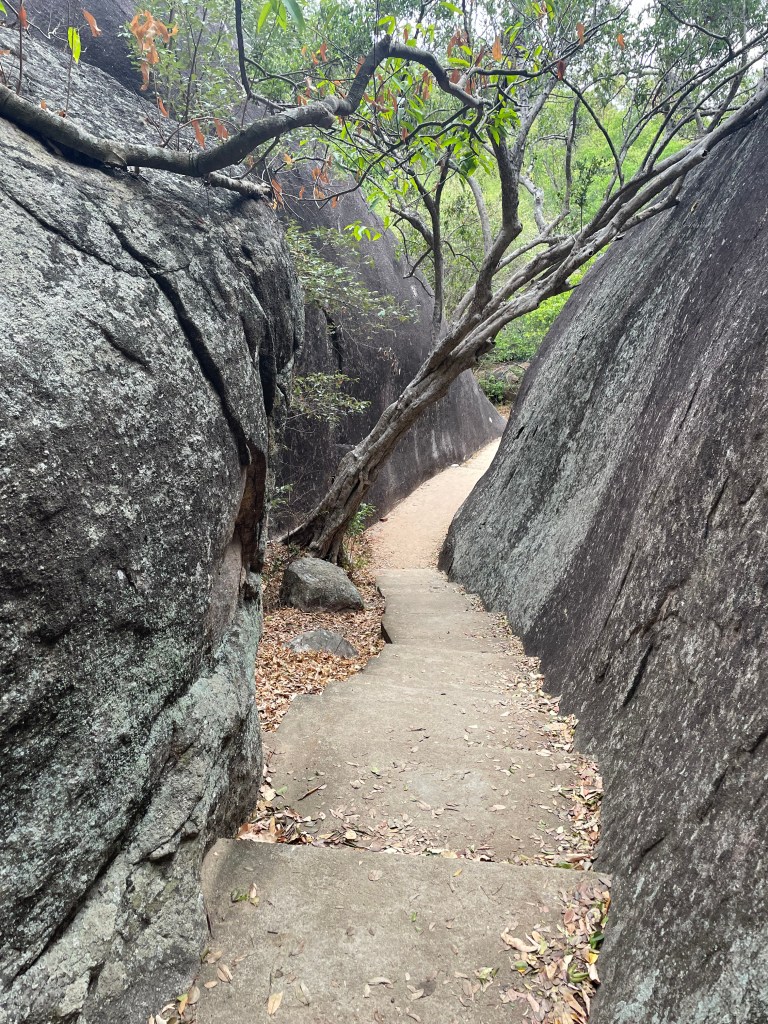
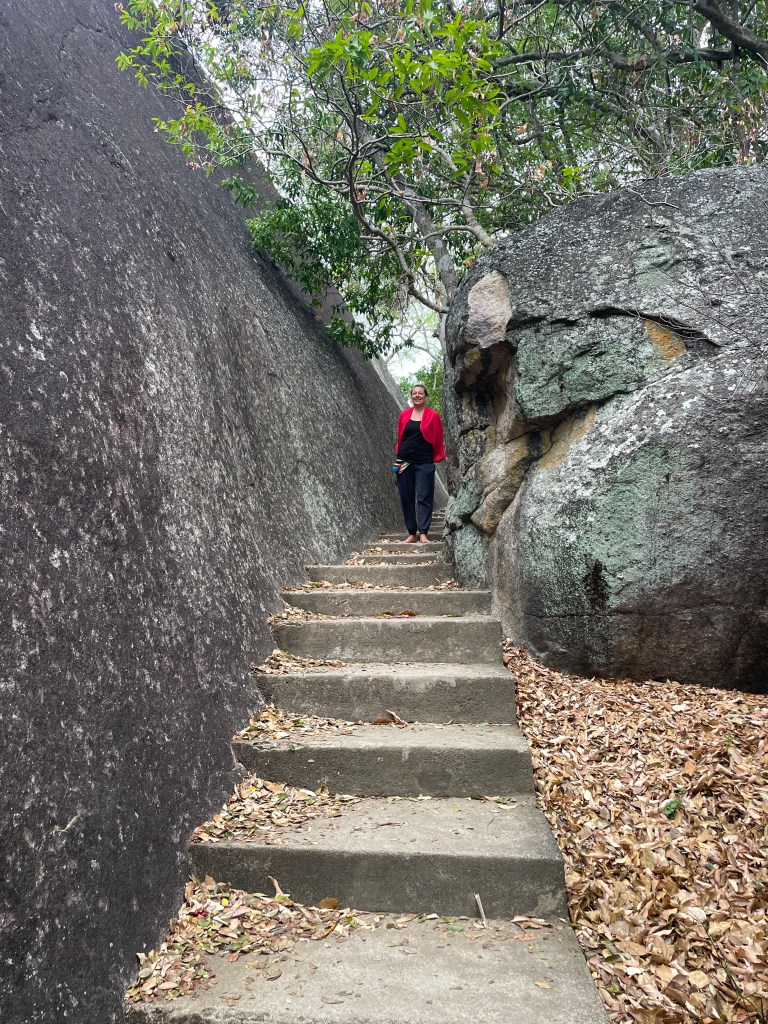
There are some stairs that have been rebuilt over time, but the majority of them exist in the state that they have been for centuries (millenia). The footpaths and stairs take a serpentine path between these boulders and granite formations throughout the entire complex, creating a meditative space unlike any other I have found.
“Today, there is no human habitation around this historic Aranya. Kudumbigala stands, towering in silent splendour, a solitary landmark and witness to the untold stories that get written into landscapes, buried, unearthed and erased yet once again. That is the sad tale of the Sinhalese civilization, which unfortunately do not deserve that fate”.
This is a quote from a Sri Lankan travel site. I felt like it described these old historic sites so well: so much better than I could find words for it. I left a link for the page here:
https://amazinglanka.com/wp/kudumbigala/
I feel like it provides a counterpoint to so many examples we see on a daily basis, of people of many different religious beliefs living peacefully, day to day, at this time in Sri Lanka. I think they all just want peace now. Thirty years of war is too much on an island this small… or anywhere.
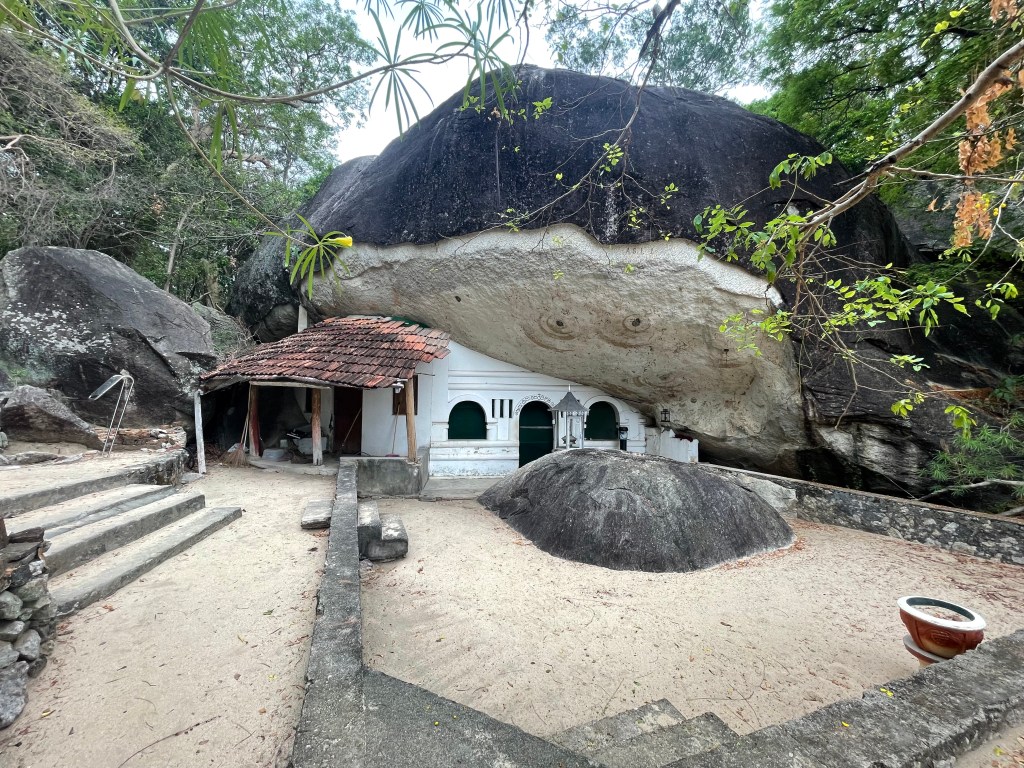
There are several areas that have been rebuilt, or added onto, over the years. This small domicile was built into one of the hundreds of previously inhabited caves they have discovered here. The practice of carving out drip edges to keep water out of the caves coincides with roughly the same time frame of the similar construction by the Buddhist monks and inhabitants of Sigiriya, about three hundred kilometers away.
This entire complex was built in 246 BC, as Sigiriya to the North was started about two hundred years earlier.
My brain has a difficult time of it sometimes, to imagine this period of time and to understand the capabilities they had for manual labor. None of this work we see here in Sri Lanka would be easy with modern tools, not to mention with the basic hand tools they possessed at the time. And then you have to factor in the fact that all this work – carving hundreds of steps and walls and water diversions – was cut from, and into, the hardest of granite rock.
It demonstrates the most stalwart belief in one’s faith to perform this work for nothing more than personal spiritual fulfillment.
I do always get a sense, though, of just how ancient these sites are when walking the pathways and stairs. You can see, actually feel, the smoothness of the crystalline granite that you are walking on, and understand how many years and how many footsteps it takes to wear a path into solid granite. These are the moments when a sense of the duration of time comes to me, and I find it deeply humbling.
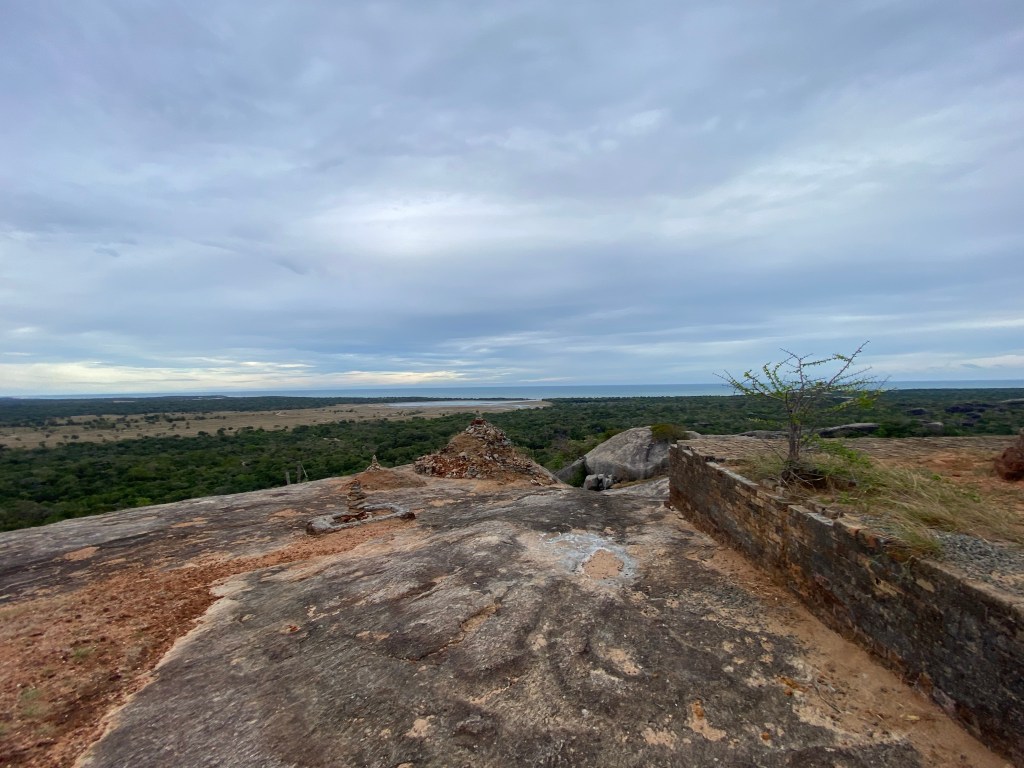
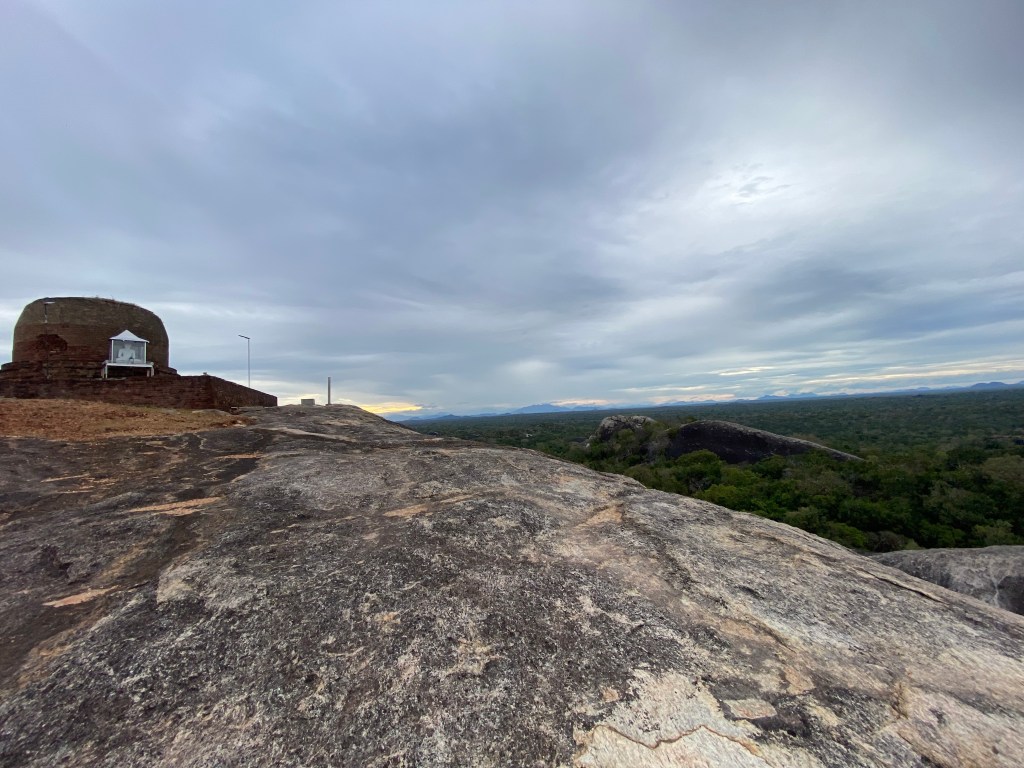
On top of the highest rock formation sits the only surviving cylindrical dagaba in Sri Lanka. It was built at the same time as the rest of the work, in 246 BC. The view from there is worth the hundreds of hand carved seps you have to climb to get there. The view of the surrounding area from the distant mountains to the nearby Indian Ocean looks over local savanna and scrub forest, and over all the animals that wander about the Kumana National Park (more on the animals in part three).
All in all, our Sunday afternoon adventure left me with a beautiful sense of my impermanence, and the deepest respect for the strength of people’s belief systems that they would build such monuments to those beliefs.
I find peace in the awareness of impermanence, and take solace in the sharing of footsteps thousands of years old.

 Wind, Water, Waves, Wander
Mike, beautifully written description. I’m so glad you included photos, even though I know they don’t do justice to the scenes you describe. Thanks for sharing your journey. ~betsy
>
LikeLiked by 1 person
Betsy! Thank you for taking the time to read these posts. It is always difficult to put your thoughts out there, but to know they are being enjoyed helps a bunch. Hope you and Hopper are well!
LikeLiked by 1 person
Love reading them, Mike! I read them all, even though I don’t comment on them all. Just know that you are not writing to a vacuum. Living vicariously through you & Tam. xoxo, betsy💛
>
LikeLiked by 1 person