We spent two and a half weeks in Dublin, and we liked it.
But…
Dublin seems like a big city that was designed by someone without a ton of creativity. There are some beautiful spots there, really nice architecture and engineering, but it seems like they just gave up designing and started repeating the best parts after a few small successes. There are a couple million people in the greater Dublin area, and I began to wonder how they all find their own houses after a night out at the pub.
It all sort of looks the same.
Then we went to Belfast.
We know that Belfast is in Northern Ireland, which is part of the UK, and we have all read something about the thirty years of “the troubles” there, but I was surprised by the obviousness of the differences.
It’s like you are entering a different country as you drive North into the UK (well, because you are), but it looks, smells, feels, and speaks differently than the South.
But yet it remains so Irish at the same time.
And Belfast seems more, well, human than Dublin.
There are no pictures of Dublin in this post because… well, because there just aren’t.
Not that it’s not beautiful. It is. Dublin is a gorgeous old city, with cathedrals and churches and museums and historical sites and bridges and all manner of amazing architecture and human accomplishment to take in.
But it’s all just a bit stodgy and boring.
The streets are clean, and safe. The alleyways are wide, clean, and smell of coffee shops and potted flowers. The people are dressed in business or tourist attire and seem, at the very least, nonthreatening. The art is purposefully historic, and appropriately old and serious.
It feels like the entire city is a museum, and could exist as some historic exhibit in any one of its own many museums. More than a few times I laughed as I found myself standing on a street corner, involuntarily striking a contemplative pose, hand rubbing my chin, looking in earnest at some historic something or other.
The whole thing reminded me a bit too much of a fourth-grade field trip to the museum of art… feeling like my indecorous younger self again, mugging at the cold stony statues of humorless saints and kings.
Dublin just seems to take itself a bit too seriously.
On the other hand, Belfast seems to embrace the gritty reality of it’s past with humor and self-deprecation. There are beautiful old buildings to be sure, but they are intertwined with new, lively, and interesting architecture, with the new somehow paying tribute to the old in a wholly unexpected way.


At every corner, and at every intersection lies a tableau of a real city… old buildings bearing the scars of age and human conflict standing in the shadows of the modern architecture, and covered in and surrounded by the colorful creations of the people with a story to tell about the place.


The Nomadic, used as the Titanic’s shallow-water tender, sits peacefully in its slip next to the abandoned slip where its sister was built. It is a permanent exhibit now in front of the ultra-modern Titanic Belfast Museum. Both ships were completed by the Harland and Wolff Shipbuilding company in 1911.
You know the rest of that story.


Dublin feels very much like Munich to me… a bit European, stern, and, yes, sterile. It gives the impression that, while it may have problems, it has hidden the less desirable elements of itself from the day to day observer. Especially in the more “historic” tourist centers.
Where Dublin tends toward the sterile museum-like nature, Belfast seems to be defined by its people. And by expression.
In Belfast there is a much more “here we are, take us or leave us as you wish” vibe. You can see it in the streets, with real people doing real people things, the human expression on open display. You can feel it in the streets, with the occasional daylight narco-zombies shuffling about or basking unconscious in a rare Irish sunbeam, and in the strong urge to keep a hand on your wallet in your front pocket while walking about.
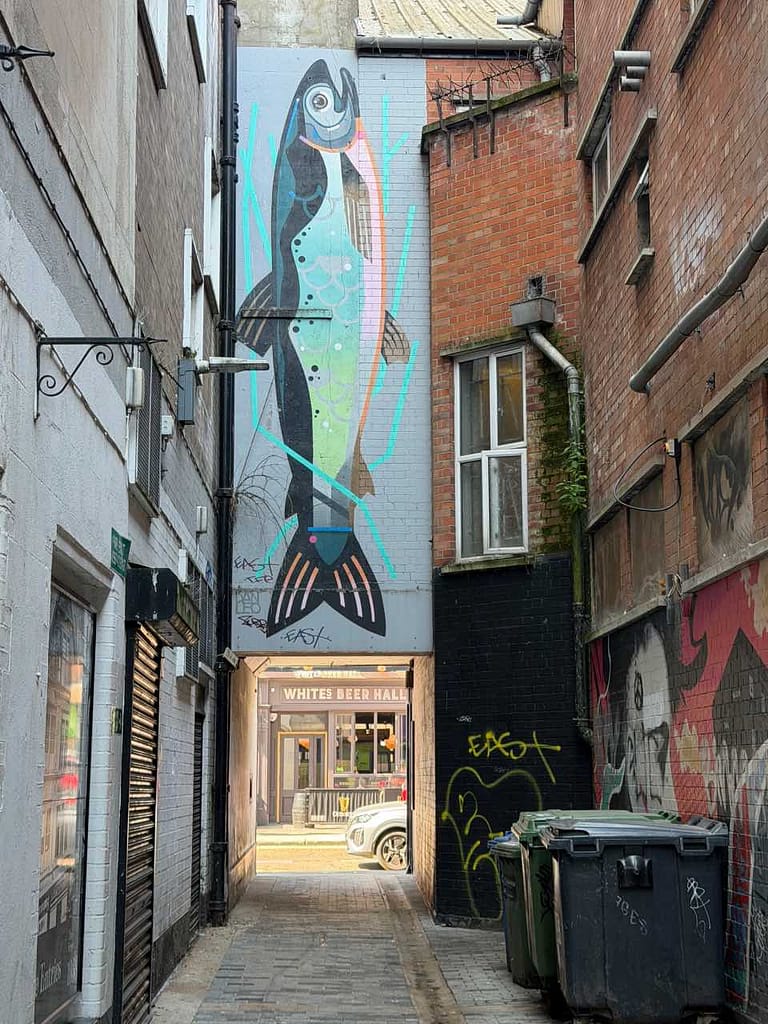
There are spaces in the old part of Belfast, alleys really, that have existed since the city was first built, dating back to the early 1600’s. As you walk through the narrow lanes, you get a sense of the history there. They are painted over with murals depicting the rich history that has contributed to the aliveness of Belfast. On a stroll through these “Entries”, as they are called, one is struck by a sense of the surreal: an almost painful dichotomy between the vibrant color and aliveness of the murals and the worn and dirty walls of the late-medieval structures. While it would be easy to bask in the romance and the art of it all, you are quickly reminded of the more human element as you are embraced by the pervasive smell of urine and stale beer in the narrow spaces.
These are alleys in a city with a thriving nightlife and a huge homelessness problem after all, despite how beautiful they may appear.
Ultimately, I like it. Belfast, that is. It reminds me that I am in a human place, with a long history of oppression, violence, troubles, and more than anything, a sense of pride in having been through the shit and come out the other side stronger for it. The folks I have met here are proud people, and they deserve to be. They have been through it, but they have survived. So has their artistic expression… as well as their sense of humor:

This is called the “Salmon of Knowledge”, or “The Big Fish”. It is a thirty-three foot long sculpture of a salmon covered in ceramic tiles, each with a story or historical event from Belfast’s past, and built to celebrate the return of salmon to the River Lagan. It is based on an old Irish myth of a salmon that ate some hazelnuts that had fallen into the well of knowledge and gained all the knowledge contained therein. It is said that if you kiss the salmon (or eat it, in some retellings) that you will then gain all of that same knowledge.
Maybe I will just read the stories on the tiles.

The coat of arms of Belfast has all the usual symbolism about being grateful to the lord and the city for what is offered, and to it’s rich maritime history, but also a sneaky little jab of humor: There is a bell above the ship in the center. It is a visual pun for the “Bell” sound in Belfast.

This 64 foot-tall statue is called the “Beacon of Hope”, and was built on the waterfront in 2007. It is hard to tell from this picture, but she is holding up a ring that symbolizes thanksgiving (no, not the US version), and she stands on a globe that symbolizes peace and harmony. While I love the message that this statue (the second largest in Belfast) stands for, I think it stands as another example of the people of Belfast’s ability to interject humor into their reverence. This statue has a few nicknames, like “Nuala with the Hula”, “The Belle on the Ball”, or “the Whoore with the Hoop”.

If you hold your breath long enough to pass through the odors, stroll down one of the many Entries in downtown Belfast, and look around, you may just find some hidden gems. There are amazing little tidbits and tributes hiding all over. This one is a tribute to the famous Belfast journalist named Robert Wilson, who wrote under the pseudonym Barney Maglone until he died in 1875. He was a much loved character for his witty, bohemian style of writing and support of the local people and “tenant farmers”.
The fact is, I have really come to love Ireland. In large part, that appreciation is for the people. All the Irish folks that I have met, either from North or South, are friendly to the utmost, generous, and very, very proud of their heritage. They have had an amazing past, with a rich, unique history of mythology, legend, good times, tough times, and storytelling.
It doesn’t matter if you are in the countryside of County Cork, in stodgy old Dublin, or in the gritty and vibrant Belfast, everyone you meet has that indomitable Irish pride and sense of humor.
But Belfast, in all of it’s “realness” — the odors and the colors, the violence and the tolerance, and the reverence and the humor of it all — is still my favorite.
